

Introduction
Every cricket fan remembers that moment. The first over of a T20 match. The crowd is loud. The batter takes strike. And then the commentator says it: “We are in the powerplay now.” But what does that actually mean?
If you are new to cricket, the word “powerplay” can sound confusing. It sounds like some special rule, and in a way, it is. A powerplay is a fixed set of overs at the start of an innings when the fielding team must keep most of its players close to the batter. This gives the batting side a real chance to score boundaries and get off to a fast start.
Understanding what is the meaning of powerplay in cricket is one of the easiest ways to enjoy limited-overs matches. It explains why the first few overs of a T20 are so aggressive. It also helps you understand why ODI innings have clear phases. In this article, we will break down the meaning, the rules, and why the powerplay matters so much—all in simple English.
What Is the Meaning of Powerplay in Cricket?
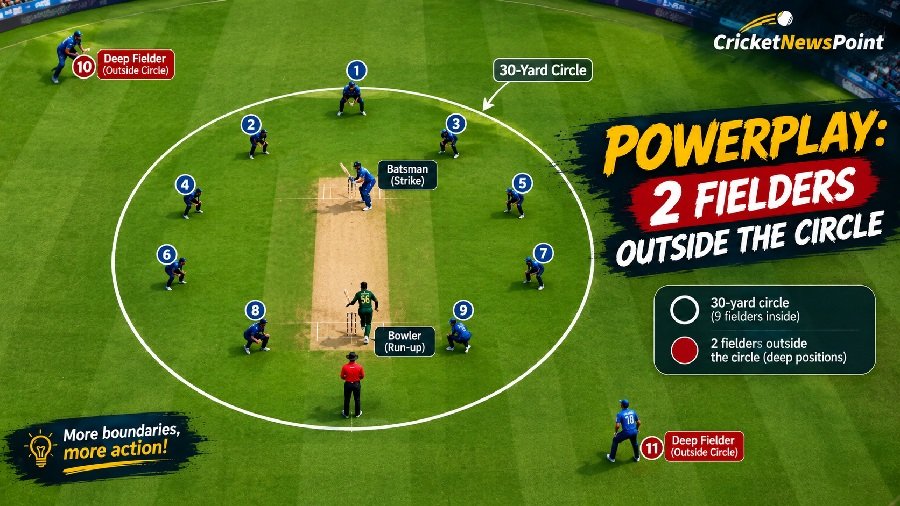
In simple words, a powerplay is a fixed block of overs at the start of an innings when the fielding team faces restrictions on where its players can stand. During this time, only a small number of fielders are allowed outside the 30-yard circle (the marked ring around the pitch). The rest must stay inside, close to the batter.
The idea is simple: fewer fielders on the boundary means more gaps for the batsman to hit through. This encourages attacking batting and higher scores. The bowling team, in return, tries to take wickets by tempting the batter into risky shots.
Powerplays exist only in limited-overs cricket—One Day Internationals (ODIs) and Twenty20s (T20s). They are not part of Test cricket.
Why Is Powerplay Important in Cricket?
The powerplay often decides the shape of an innings. In T20 cricket, teams try to score as many runs as possible in the first six overs because fielding restrictions make boundaries easier. A strong powerplay can put the batting team in control. A poor one can leave them struggling to catch up.
For bowlers, the powerplay is a chance to strike early. With batters trying to attack, edges and mistimed shots can lead to wickets. The ICC has noted that while more runs are scored during powerplays, more wickets also tend to fall, making the game more exciting .
Captains also have to think carefully. They must decide which bowlers are best suited to bowl with a restricted field, and how to protect the boundary while still attacking.
Powerplay Rules in ODI Cricket
ODI cricket has a clear structure for fielding restrictions. Under the current rules, a 50-over innings is divided into three phases:
- Overs 1 to 10 (Powerplay 1): Only two fielders are allowed outside the 30-yard circle. This is the main powerplay.
- Overs 11 to 40: Up to four fielders can stand outside the circle.
- Overs 41 to 50: Up to five fielders can stand outside the circle.
These rules have been in place since 2015, when the ICC removed the older “batting powerplay” and compulsory close catchers . The mandatory powerplay at the start of the innings is the only part officially called a “powerplay” in modern ODIs, though the later phases also have fielding limits.
Powerplay Rules in T20 Cricket
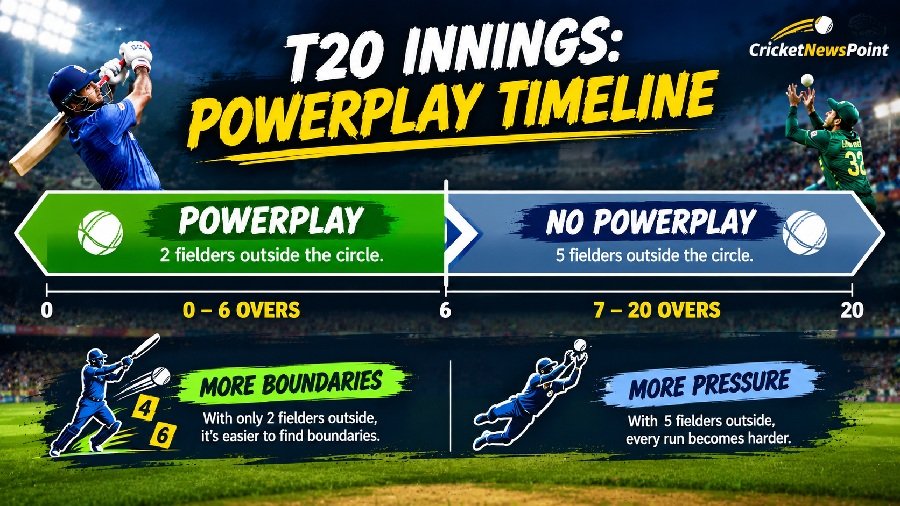
T20 cricket has a shorter and simpler powerplay. In a full 20-over innings:
- Overs 1 to 6: Only two fielders are allowed outside the 30-yard circle.
- Overs 7 to 20: Up to five fielders can stand outside the circle.
This six-over powerplay is a fixed part of every T20 innings. The ICC recently updated the rules for rain-shortened matches. Instead of rounding powerplay overs to the nearest full over, the calculation is now made to the nearest ball. For example, an eight-over innings now has 2.2 overs of powerplay instead of three . This change keeps the powerplay roughly 30 percent of the innings, matching the standard six-out-of-20 ratio.
Is There a Powerplay in Test Cricket?
No. Powerplays do not exist in Test cricket. Test matches have no fielding restrictions based on overs, and captains can set fields freely at any time. The powerplay is a tool designed for limited-overs cricket, where innings are short and scoring rates matter more. This is why you will only hear the term in ODI and T20 matches.
Batting vs Bowling During Powerplay
Batting strategy: Batters try to take advantage of the gaps. With only two fielders outside the circle in the early powerplay, hitting boundaries is easier. Openers often play aggressive shots, especially in T20 cricket. In ODIs, some teams prefer a slightly cautious start, while others attack from ball one.
Bowling strategy: Bowlers aim to restrict scoring and take wickets. They may bowl fuller lengths to encourage drives, or use variations to force mistakes. Captains often use their best new-ball bowlers during the powerplay. The risk for bowlers is that aggressive batting can lead to quick runs, so accuracy is crucial.
Powerplay Example for Beginners
Imagine a T20 match. It is the first over. The fielding captain can only place two fielders on the boundary. The rest of the fielders must be inside the 30-yard circle. The batter knows this, so he feels confident trying to hit over the infield. If he times the ball well, it can reach the boundary because there are fewer fielders out there to stop it.
Now imagine the seventh over. The powerplay is over. The captain can now place five fielders on the boundary. The same shot that would have been a four in the first over might now be caught on the rope. This is why scoring often slows down after the powerplay ends.
Comparison Table: ODI vs T20 Powerplay Rules
| Feature | ODI (50 overs) | T20 (20 overs) |
|---|---|---|
| Powerplay duration | Overs 1–10 | Overs 1–6 |
| Fielders outside circle (powerplay) | 2 | 2 |
| Fielders outside circle (after powerplay) | 4 (overs 11–40), 5 (overs 41–50) | 5 (overs 7–20) |
Powerplay FAQs
What does powerplay mean in cricket?
A powerplay is a period in limited-overs cricket when fielding restrictions apply. Only two fielders are allowed outside the 30-yard circle, helping batters score more freely.
How many overs are in a T20 powerplay?
In a full 20-over T20 innings, the powerplay lasts for the first six overs. In rain-shortened matches, the number is scaled based on the total overs.
How many overs are in an ODI powerplay?
In a standard 50-over ODI, the main powerplay covers the first 10 overs. After that, fielding restrictions ease in two later phases.
How many fielders can stay outside the circle during powerplay?
Only two fielders are allowed outside the 30-yard circle during the powerplay in both ODI and T20 cricket.
Why is powerplay important in cricket?
It creates an exciting phase where batters attack and bowlers hunt for wickets. It often sets the tone for the rest of the innings.
Conclusion
The meaning of powerplay in cricket is simple: it is a period of fielding restrictions that encourages attacking batting. In ODIs, it covers the first 10 overs. In T20s, it covers the first six. Understanding this rule helps you follow the flow of a limited-overs match and appreciate why the first few overs are often so dramatic. Whether you are watching a T20 blast or a 50-over classic, the powerplay is one of the most important phases of the game.