


Introduction: DLS Method Cricket
Rain stops play. The players walk off. The fans wait nervously. And then the big question comes: who wins?
In cricket, this exact situation has caused heartbreak and celebration for decades. The answer lies in the DLS method — the system that decides rain-affected matches fairly.
If you have ever watched a match get interrupted and wondered how the target suddenly changed, this guide is for you. We will break down the DLS method in cricket in simple terms — what it means, how it works, and why it matters in every limited-overs game.
Whether you are a casual fan or a die-hard cricket lover, understanding DLS will change how you watch rain delays forever.
What Is the DLS Method in Cricket?
DLS stands for Duckworth-Lewis-Stern. It is a mathematical formula used to calculate revised targets when a limited-overs match is interrupted by rain or bad weather .
Here is the simple idea: when overs are lost, both teams lose some ability to score runs. DLS tries to work out how much each team lost and sets a fair new target .
The method was created by English statisticians Frank Duckworth and Tony Lewis. It was first used in 1997 and officially adopted by the ICC in 1999 .
In 2014, Australian professor Steven Stern updated the formula. That is when the “S” was added — making it Duckworth-Lewis-Stern .
How Does the DLS Method Work?
The DLS method is based on one simple concept: resources.
Every team has two resources when they bat:
At any point in the innings, these two resources combine to give a percentage. If a team has 100% resources at the start, losing overs or wickets reduces that percentage .
When rain interrupts, DLS calculates:
- How many resources Team 1 had when play stopped
- How many resources Team 2 will have when they bat
- What target makes the game fair for both sides
The key point: it is not just about run rate. A team with 8 wickets in hand and 15 overs left is much stronger than a team with 2 wickets in hand and 15 overs left. DLS understands this difference .
Why Was DLS Needed? The Problems with Old Methods
Before DLS, cricket used two main methods — and both had serious problems.
Average Run Rate (ARR): The chasing team just had to match the first team’s run rate. The problem? This method ignored wickets completely. A team could be 100/9 and still be declared the winner if their run rate was high enough .
Most Productive Overs (MPO): This method subtracted the runs scored in the least productive overs. But it punished teams for bowling too well. If a team bowled 20 maiden overs, those overs were removed — making the target unfair .
The final straw came in the 1992 World Cup semi-final. South Africa needed 22 runs from 13 balls against England. Rain stopped play. When they returned, the target became 21 runs from one ball. It was impossible. South Africa lost in farcical circumstances .
This disaster led to the creation of the Duckworth-Lewis method.
How DLS Targets Are Calculated (Simple Example)
Let us walk through a simple example to make DLS easy to understand.
Scenario: A 50-over match. Team 1 scores 250/5 in their 50 overs.
Rain interrupts before Team 2 bats. The match is reduced to 40 overs for Team 2.
According to DLS, Team 2 has fewer resources — they lost 10 overs. But they still have all 10 wickets. The DLS target might become around 225 runs in 40 overs .
Now consider this: Team 1 was 200/8 after 40 overs when rain stopped their innings. They were struggling. They lost their last 10 overs with only 2 wickets left.
DLS sees this differently. Team 1 lost less “resource” because they were already in trouble. The target for Team 2 might actually go down instead of up .
This is why DLS targets sometimes surprise fans. It is not just about runs — it is about when the interruption happened and how many wickets were left.
DLS vs VJD: What Is the Difference?
The VJD method is an alternative to DLS, created by V. Jayadevan, a civil engineer from Kerala, India .
Key differences between DLS and VJD:
- DLS uses one curve to estimate scoring patterns. VJD uses two curves — one for the team batting before rain, one for the team batting after
- VJD divides the innings into phases: high scoring in Powerplay, slower in middle overs, and a rise again in slog overs
- VJD is used in Indian domestic cricket like the Vijay Hazare Trophy and TNPL. DLS is used internationally
The ICC reviewed VJD in 2012 but rejected it, saying there was “no evidence of any significant flaws” in DLS . So DLS remains the global standard.
Quick comparison for a 20-over target:
| Team 1 Score | DLS Target | VJD Target |
|---|---|---|
| 150 | 93 | 91 |
| 200 | 124 | 118 |
| 250 | 154 | 142 |
| 300 | 163 | 163 |
| 350 | 174 | 182 |
Famous DLS Moments in Cricket History
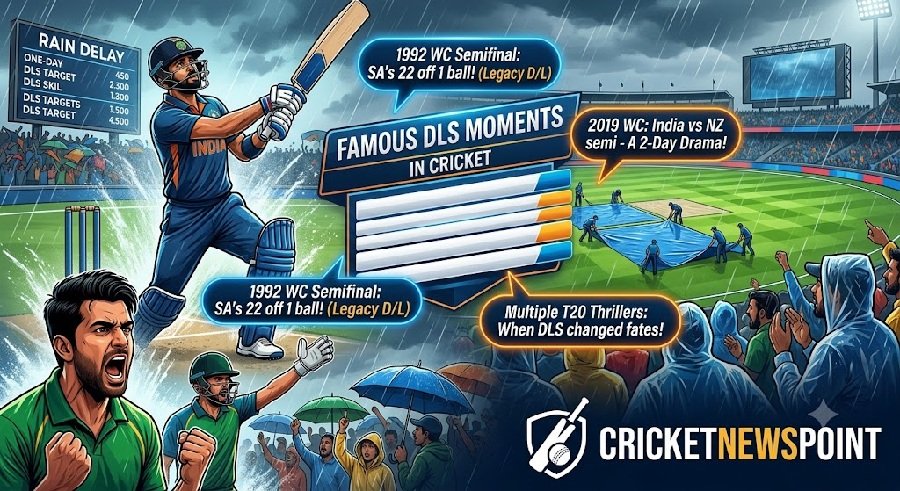
DLS has created some unforgettable — and controversial — moments.
India vs Bangladesh, T20 World Cup 2022: Bangladesh were 66/0 after 7 overs, chasing 185. Rain reduced the target to 151 from 16 overs. Bangladesh collapsed and lost by 5 runs .
India vs New Zealand, 3rd T20I 2022: India were 75/4 after 9 overs, chasing 161. Rain came. DLS showed India were exactly on par. India won the series 1-0 .
India vs Ireland, 1st T20I 2023: India were 47/2 when rain stopped play. DLS calculations showed India were ahead by just 2 runs. India won by 2 runs (DLS) .
1992 World Cup Semi-Final: The disaster that started it all. South Africa needed 22 from 13 balls. After rain, they needed 21 from 1 ball .
2019 World Cup Semi-Final: India vs New Zealand was pushed to a reserve day after rain stopped play with New Zealand on 211/5 after 46.1 overs. The match continued the next day .
Summary Table: DLS Method Quick Facts
Conclusion: Is DLS Fair?
The DLS method is not perfect. Fans and players still debate its decisions. Some say it favors the team batting second. Others say high-scoring teams get shortchanged .
But here is the truth: DLS is the fairest system cricket has ever had.
Before DLS, rain rules were genuinely unfair. Teams won or lost based on outdated calculations. DLS brought science and logic to a difficult problem .
The method has its critics, but no better alternative has been accepted internationally. Even VJD, which is used in India, has similar limitations.
For Indian cricket fans, DLS is part of the game now. Whether it saves India or breaks Indian hearts, it adds drama to every rain delay. The next time rain stops play, you will know exactly what is happening — and why.
FAQ Section
Q1: What is the full form of DLS in cricket?
DLS stands for Duckworth-Lewis-Stern. It is named after Frank Duckworth, Tony Lewis, and Steven Stern .
Q2: How does DLS calculate the target score?
DLS uses a formula based on overs remaining and wickets lost. It calculates how many resources each team has and sets a fair target .
Q3: Why is DLS used in cricket?
DLS is used to decide rain-affected matches fairly. Before DLS, methods like Average Run Rate and Most Productive Overs gave unfair results .
Q4: What is the difference between DLS and VJD?
DLS is the international standard. VJD is an Indian alternative used in domestic cricket. VJD uses two curves and divides innings into phases .
Q5: When was DLS first used in cricket?
DLS was first used in 1997 during a Zimbabwe vs England ODI. The ICC adopted it officially in 1999 .