


Introduction
If you are learning cricket, one question comes up quickly: how many types of wickets in cricket are there? The answer is 10. Under the Laws of Cricket, a batter can be dismissed in ten different ways, though some are far more common than others .
But before we count them, there is a small confusion to clear up. In cricket, the word “wicket” has two meanings. It can mean the set of three stumps and two bails at each end of the pitch . It can also mean a batter’s dismissal—when a player is given out and must leave the field. This article focuses on the second meaning: the ten ways a batter can lose their wicket.
What Is the Difference Between a Wicket and a Dismissal?
The wicket itself is physical. It is three wooden stumps, 28 inches tall, with two bails resting on top . The fielding team tries to hit this wicket with the ball to dismiss the batter.
A dismissal, on the other hand, is the official end of a batter’s innings. When a batter is dismissed, they are “out” and cannot bat again in that innings. The team is said to have “lost a wicket” . So when people ask about “types of wickets,” they usually mean types of dismissals.
How Many Types of Wickets in Cricket? All 10 Methods
Here are the ten ways a batter can be dismissed under the MCC Laws of Cricket.
1. Bowled
The bowler delivers the ball, and it hits the stumps directly, knocking the bails off. The wicket must be “put down”—meaning the ball completely removes a bail or strikes a stump out of the ground .
Example: A fast bowler sends down a yorker. The batter is too late, and the ball crashes into the middle stump. That is bowled.
2. Caught
The batter hits the ball with the bat (or glove holding the bat), and a fielder catches it before it touches the ground. The catch must be clean and completed.
Example: A batter drives the ball in the air toward cover. The fielder dives forward and takes the catch inches from the grass. The batter is out caught.
3. Leg Before Wicket (LBW)
This is one of the trickier rules. The batter is out LBW if the ball hits their leg (or body) when it would have gone on to hit the stumps, and certain conditions are met. The umpire must judge whether the ball would have hit the wicket “but for the interception” .
Example: A batter misses a straight delivery, and the ball hits their pad right in front of the stumps. The umpire decides the ball would have hit middle stump. Out LBW.
4. Run Out
A batter is run out when they are out of their ground (the crease area) and the fielding team puts down the wicket before they return. This often happens while attempting a run .
Example: Two batters try for a quick single. The fielder throws the ball to the stumps, and the batter is short of the crease. The bails come off. Run out.
5. Stumped
This is similar to a run out, but it involves the wicketkeeper. The batter is stumped if they leave their crease to play a shot, miss the ball, and the wicketkeeper puts down the wicket before they can return .
Example: A batter charges down the pitch to hit a spinner. They miss, and the wicketkeeper collects the ball and breaks the stumps. Stumped.
6. Hit Wicket
The batter is out if they knock over their own wicket with their bat or body while playing a shot or preparing to play one.
Example: A batter steps back to cut a ball but accidentally kicks their leg stump. The bail falls. Hit wicket.
7. Hit the Ball Twice
A batter cannot deliberately hit the ball twice with the bat or body. The only exception is if they are using the second hit purely to protect their wicket from being bowled .
Example: A batter hits the ball, sees it rolling toward the stumps, and deliberately smacks it away with the bat. That is out hit the ball twice.
8. Obstructing the Field
If a batter deliberately blocks a fielder from taking a catch or attempting a run out, they can be given out for obstructing the field . The 2017 Laws merged the old “handling the ball” dismissal into this rule.
Example: A batter hits the ball and then deliberately blocks a fielder’s throw with their body to stop a run out. Out obstructing the field.
9. Timed Out
After a wicket falls, the next batter must be ready to face the next ball within a set time. Under the Laws, this is two minutes (120 seconds) . If they are not ready, they can be given out timed out.
Example: A new batter takes too long to walk to the crease or adjust their gear, and the fielding team appeals. The umpire gives them timed out.
10. Retired Out
If a batter leaves the field voluntarily without the umpire’s permission, and not because of injury or illness, they are “retired out” . They cannot return to bat unless the opposing captain allows it .
Important: This is not the same as Retired Hurt. A batter who retires hurt due to injury or illness is not out. They can return to bat later in the innings if they recover . Retired hurt is not a dismissal. Retired out is.
Summary Table of All 10 Dismissals
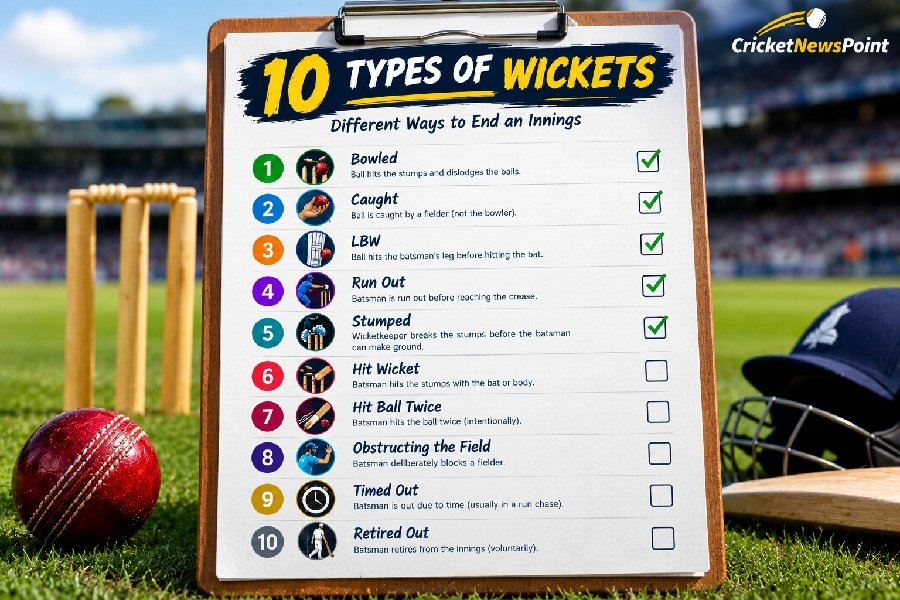
| Dismissal Type | Simple Meaning |
|---|---|
| Bowled | Ball hits the stumps directly |
| Caught | Fielder catches the ball before it touches the ground |
| LBW | Ball hits batter’s leg/body when it would have hit the stumps |
| Run Out | Batter is out of their ground when the wicket is put down |
| Stumped | Wicketkeeper puts down the wicket while batter is out of their crease |
| Hit Wicket | Batter knocks over their own stumps |
| Hit the Ball Twice | Batter deliberately strikes the ball twice |
| Obstructing the Field | Batter deliberately blocks a fielder |
| Timed Out | New batter is not ready within the allowed time |
| Retired Out | Batter leaves voluntarily without permission |
Which Dismissals Are Most Common?
The most common dismissals in cricket are caught, bowled, LBW, run out, and stumped. These happen regularly in every format. The other five—hit wicket, hit the ball twice, obstructing the field, timed out, and retired out—are rare. Timed out, for example, had never happened in ODI cricket until Angelo Mathews was dismissed that way in the 2023 World Cup .
How Wickets Work in Different Formats
The ten dismissal rules are the same across Test, ODI, and T20 cricket. What changes is the number of wickets available.
- Test cricket: Each team has 10 wickets per innings. A Test match has up to four innings.
- ODI cricket: Each team has 10 wickets for one innings of 50 overs.
- T20 cricket: Each team has 10 wickets for one innings of 20 overs.
In all formats, once a team loses 10 wickets, their innings is over . This is why teams try to protect their wickets—once they are gone, no one is left to bat.
FAQs
1. How many types of wickets are there in cricket?
There are 10 ways a batter can be dismissed under the Laws of Cricket: bowled, caught, LBW, run out, stumped, hit wicket, hit the ball twice, obstructing the field, timed out, and retired out .
2. Is retired hurt a type of wicket?
No. Retired hurt is not a dismissal. A batter who retires hurt due to injury is not out and can return to bat later. Retired out, however, is a dismissal .
3. What is the most common way to get out in cricket?
Caught is usually the most common dismissal, followed by bowled and LBW. The exact numbers vary by format and match.
4. Can a batter be out without the ball hitting the stumps?
Yes. Caught, LBW, run out, stumped, timed out, and retired out do not require the ball to hit the stumps directly. Only bowled, hit wicket, and some run outs involve the wicket being put down by contact with the ball or the batter.
5. What happens if a team loses all 10 wickets?
The innings ends. The team cannot bat any further because there are no batters left. This is why wickets are so valuable in cricket.
Conclusion
So, how many types of wickets in cricket? The answer is 10 dismissals under the MCC Laws. Five are common—bowled, caught, LBW, run out, and stumped. The other five are rare but still part of the rules. Understanding these dismissals makes watching cricket much easier, because you will know exactly why the umpire raised that finger.


