
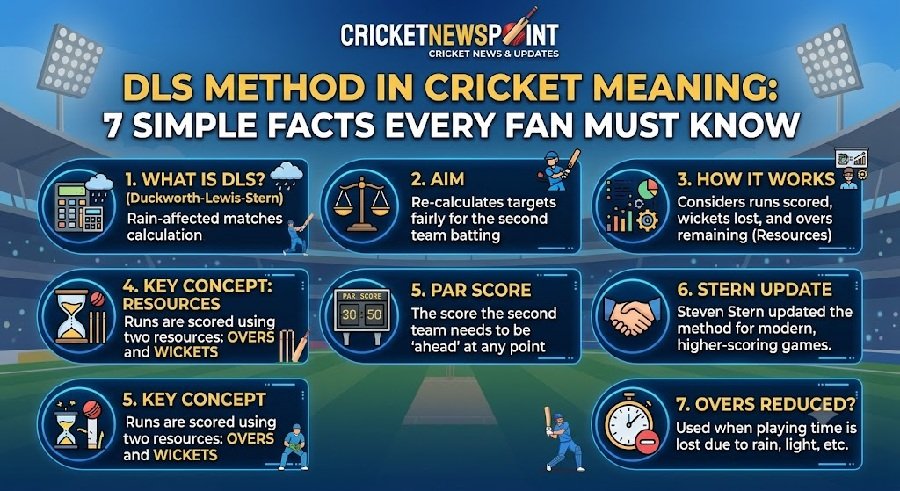

DLS Method in Cricket Meaning: Introduction
Rain and cricket have a complicated relationship. One moment the sun is shining, the next moment the covers are on, and players are walking off the field. In the past, this meant matches would end without a result, leaving fans frustrated and teams confused.
Then came the DLS Method in Cricket Meaning — a system that changed how rain-affected matches are decided. Whether you are a beginner learning the game or a longtime fan who wants to understand what those numbers on the screen mean, this guide will explain everything in simple, natural English.
What Is the DLS Method in Cricket?
The DLS method is a mathematical formula used to calculate a fair target score for the team batting second when a limited-overs match is interrupted by rain or other weather conditions. Instead of simply reducing the target in proportion to the lost overs — which would be unfair — the DLS method looks at the actual situation of the match and sets a target that reflects how difficult or easy the chase should be.
The International Cricket Council (ICC) formally adopted this method to ensure that both teams get a fair chance to win, even when the match is shortened. It is used in One Day Internationals (ODIs), T20 Internationals, and domestic limited-overs matches around the world.
What Does DLS Stand For?
DLS stands for Duckworth-Lewis-Stern. Each name belongs to a person who contributed to developing or improving this method:
- Frank Duckworth and Tony Lewis were two English statisticians who created the original formula in 1997.
- Steven Stern, an Australian professor, became the custodian of the method after Duckworth and Lewis retired. His name was added in 2014 to reflect the updates he brought to the system.
So when you see “DLS Method” mentioned on TV or in scorecards, it is simply a shorter way of saying “Duckworth-Lewis-Stern.”
Why Is the DLS Method Used?
Before the DLS method existed, rain-affected matches were often decided by simple run-rate calculations. This led to confusing and sometimes unfair outcomes. The most famous example came during the 1992 World Cup semi-final between South Africa and England, where South Africa’s target was reduced from 22 runs off 13 balls to 22 runs off just one ball after a rain delay. It was an impossible task and left everyone unhappy.
The DLS method was created to solve this problem. Its main goals are:
- To set a fair target for the team batting second.
- To account for both wickets lost and overs remaining, not just overs.
- To give both teams a realistic chance to win the match.
- To remove confusion when results are decided by rain interruptions.
How Does the DLS Method Work?
The DLS method works on a simple principle: every team in a limited-overs match has two resources available to score runs — overs remaining and wickets in hand.
At any point in the match, the combination of these two resources is calculated as a percentage. This percentage tells us how much “run-scoring potential” a team has left. The DLS tables have pre-calculated values for every possible situation, covering each ball of the match.
When rain interrupts play, the match officials use these tables to:
- Find the resource percentage the first team had when their innings was interrupted.
- Find the resource percentage the second team will have after the revised number of overs.
- Compare the two percentages and adjust the target score accordingly.
If the team batting second has fewer resources available than the team batting first had, the target is reduced. If they have more resources (which can happen when the first team’s innings was interrupted), the target is increased.
A Simple Example of a DLS Target Calculation

Let us understand this with a realistic example.
Imagine an ODI match where Team A bats first and scores 250 runs in 50 overs. During the innings break, rain reduces the match to 40 overs per side for Team B.
In this situation, Team B has fewer overs to score, but they also know exactly how many runs they need to chase. However, they also have all 10 wickets in hand, which is an advantage compared to a team that has already lost wickets.
The DLS method calculates that Team B has about 90% of the resources that Team A had (because they have fewer overs but all wickets in hand). So instead of needing 250 runs, their revised target might be around 225 runs in 40 overs.
The exact number depends on the official DLS table used for that specific match. The key point is that the target is adjusted based on both overs lost and wickets remaining — not just a simple run-rate calculation.
What Are Resources in the DLS Method?
In the DLS method, “resources” refers to the two things a batting team uses to score runs:
| Resource | Meaning | Why It Matters |
|---|---|---|
| Overs Remaining | How many balls are left to be bowled | More overs means more chances to score |
| Wickets in Hand | How many batsmen are still available | More wickets means batsmen can take more risks |
The DLS tables give a percentage value to every combination of these two resources. For example, a team with 50 overs left and 10 wickets in hand has 100% resources. A team with 25 overs left and 10 wickets in hand might have around 60-65% resources. A team with 10 overs left and only 3 wickets in hand might have just 15-20% resources.
The beauty of this system is that it recognizes that losing wickets is just as damaging as losing overs. A team with plenty of overs but no wickets left cannot score as freely as a team with wickets in hand.
DLS Method Rules in ODI and T20 Cricket
The DLS method has slightly different rules depending on the format:
In ODI Cricket
- A minimum of 20 overs must be completed in the second innings for a result to be declared using DLS.
- If the match is interrupted during the second innings and cannot be resumed, the team that is ahead of the par score at that moment is declared the winner.
- If the chasing team is exactly level with the par score, the match is tied.
In T20 Cricket
- A minimum of 5 overs must be completed in the second innings for a result.
- The same principle of par score applies — if the team batting second is above the par score when rain ends the match, they win.
Par Score vs Target Score
It is important to understand the difference between these two terms:
- Target Score: The final revised score the team batting second needs to win. This is a fixed number once calculated.
- Par Score: The score the team batting second should have reached at a specific point (considering wickets lost) to be “ahead” if the match ends there. The par score changes after every ball and every wicket.
Think of it this way: the target is what you need at the end. The par score is what you need right now if the rain comes again.
Difference Between the DLS Method and the Old Duckworth-Lewis Method
The original Duckworth-Lewis (D/L) method was introduced in 1997 and officially adopted by the ICC in 1999. It was a huge improvement over previous methods, but cricket changed over time.
Batsmen became more aggressive. Scoring rates increased. Teams started accelerating earlier in their innings. The old D/L method was based on data from an earlier era of cricket, so it was not always accurate for modern matches.
In 2014, Steven Stern updated the method to reflect these changes. The new DLS method uses updated resource tables based on ball-by-ball analysis of hundreds of recent international matches. The ICC analyzed over 240,000 individual deliveries from 700 ODIs and 428 T20Is to create the updated tables.
The main differences are:
- Updated resource tables that reflect modern scoring patterns.
- Better handling of T20 cricket, where scoring rates are much higher.
- More accurate par scores during the second innings.
The name changed from Duckworth-Lewis to Duckworth-Lewis-Stern to honor Steven Stern’s contribution.
Advantages and Limitations of the DLS Method
Advantages
- Fairer than older methods: It considers both overs and wickets, giving a more balanced target.
- Widely accepted: Used in international and domestic cricket worldwide.
- Updated regularly: The ICC reviews and updates the system based on new data.
- Clear rules: The par score system allows matches to be decided even if rain returns.
Limitations
- Complex to understand: For casual fans, the calculations can seem confusing.
- Does not consider team strength: A strong batting lineup and a weak one are treated the same way.
- Dew and weather conditions: The method does not account for factors like evening dew that can make chasing easier or harder.
- Not perfect: Some analyses suggest that the method may have a slight bias in certain situations.
Despite these limitations, the DLS method remains the most widely accepted and statistically sound system for deciding rain-affected matches.
Frequently Asked Questions
What does DLS mean in cricket?
DLS stands for Duckworth-Lewis-Stern. It is a mathematical method used to calculate fair target scores when a limited-overs match is interrupted by rain or other weather conditions.
Who invented the DLS method?
The original method was created by English statisticians Frank Duckworth and Tony Lewis in 1997. It was later updated by Australian professor Steven Stern, whose name was added in 2014.
What is the par score in DLS?
The par score is the score the team batting second should have reached at a specific point in the match, considering how many wickets they have lost. If the match ends at that moment, the team above the par score wins.
How many overs are needed for a DLS result in ODI?
A minimum of 20 overs must be completed in the second innings for a result to be declared using DLS in ODI cricket.
Can a team win on DLS even if they are not ahead on runs?
Yes. If the team batting second is above the par score when rain ends the match, they are declared the winner — even if their total is lower than the first team’s score.
Is the DLS method used in Test cricket?
No. The DLS method is designed for limited-overs cricket (ODIs and T20s) where each team has a fixed number of overs. Test cricket has different rules for rain-affected matches.
What happens if the DLS target is not reached?
If the chasing team ends the match below the par score (or fails to reach the target in the available overs), the team batting first wins.
Conclusion
The DLS Method in Cricket Meaning is simple once you break it down: it is a fair way to decide rain-affected matches by looking at how many overs and wickets a team has left. Instead of guessing or using simple run-rate calculations, the DLS method uses detailed statistical tables to set a target that gives both teams a realistic chance.
The next time you see a match interrupted by rain and the DLS numbers flash on the screen, you will know exactly what they mean. It is not just a random calculation — it is the result of years of research and analysis, designed to keep the game fair and exciting even when the weather does not cooperate.