
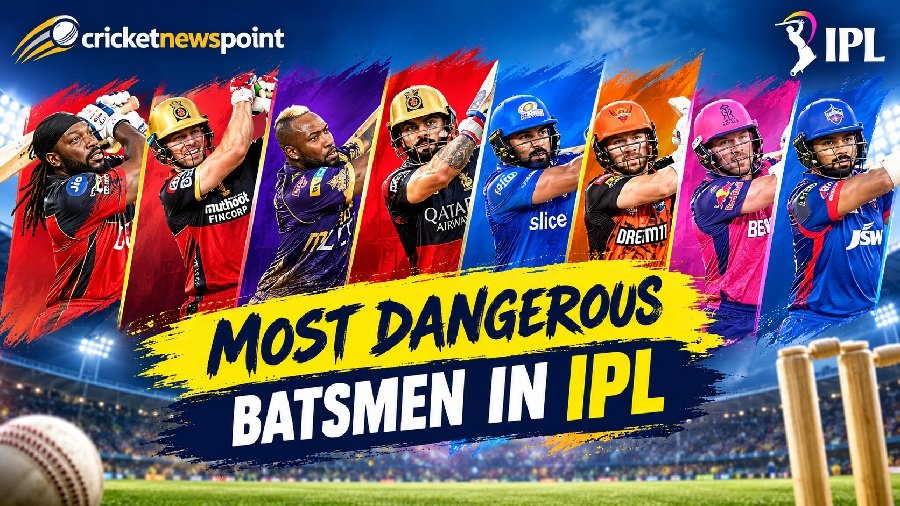

The IPL dangerous batsman is a player who can change the entire match within a few overs. In the Indian Premier League, several batters have earned this reputation through explosive stroke play, exceptional strike rates, six-hitting ability, match-winning innings and the capacity to dominate even the best bowlers.
Since the tournament began in 2008, the IPL has produced some of the most destructive T20 batters in cricket. From Chris Gayle’s enormous sixes to AB de Villiers’ unbelievable 360-degree shots, from Andre Russell’s power hitting to the emergence of young stars such as Vaibhav Sooryavanshi, the league has repeatedly shown how quickly a batter can take a game away from the opposition.
Calling someone the “most dangerous batsman” is naturally subjective. A batter can be dangerous because of power, consistency, strike rate, finishing ability, ability against spin or pace, or the capacity to score rapidly under pressure. Therefore, this list considers a combination of these qualities rather than one statistic alone.
What Makes an IPL Dangerous Batsman?
Before looking at the players, it is important to understand what makes a batsman dangerous in T20 cricket.
1. Explosive Strike Rate
A high strike rate allows a batter to score runs much faster than the opposition expects. A player scoring at 180 or 200 can transform a modest total into a huge one within a few overs.
2. Six-Hitting Ability
Sixes are one of the biggest weapons in the IPL. A batter who can consistently clear the boundary can change the momentum of a match almost immediately.
3. Ability to Attack Different Bowlers
The most dangerous batters are not dependent on one particular type of bowling. They can attack fast bowlers, spinners, yorkers, slower deliveries and short balls.
4. Match-Winning Ability
Statistics are important, but match situation also matters. A dangerous batter can produce a huge innings when the team needs it most.
5. Finishing Power
Some batters become especially dangerous during the final five overs. Their ability to score 15-20 runs from an over can completely change a chase or push a team’s total beyond 200.
Top 10 IPL Dangerous Batsman
1. Chris Gayle
When discussions about the most dangerous batsman in IPL history begin, Chris Gayle is almost impossible to ignore.
The West Indian left-hander became one of the biggest symbols of power hitting in T20 cricket. His combination of enormous physical strength, clean ball striking and ability to hit sixes from seemingly impossible positions made him a nightmare for bowlers.
Gayle’s most famous IPL innings came in 2013 when he scored an unbeaten 175 for Royal Challengers Bengaluru against Pune Warriors India. That innings remains one of the most extraordinary individual performances in T20 cricket.
Gayle also produced a remarkable IPL 2012 season, scoring 733 runs and hitting 59 sixes. Earlier IPL records from the league show how dominant his six-hitting was during that era.
His ability to attack from the opening over made him particularly dangerous. Once Gayle settled at the crease, captains often had to change their bowling plans simply to stop the flow of boundaries.
Why Gayle was dangerous
- Massive six-hitting ability
- Exceptional power against pace
- Ability to dominate spin
- Match-winning hundreds
- Destructive starts in the powerplay
- Proven record over multiple IPL seasons
2. AB de Villiers
If Gayle represented pure power, AB de Villiers represented innovation and versatility.
The former South African batter could score boundaries almost anywhere on the ground. His ability to play shots behind square, over the wicketkeeper, through the covers and even against deliveries outside off stump made him exceptionally difficult to bowl to.
AB’s famous 133 for Royal Challengers Bengaluru against Mumbai Indians demonstrated his ability to combine power with extraordinary shot selection.
One of the reasons AB became such a dangerous IPL batsman was his ability to accelerate very quickly. He did not always need a long period to settle. A few boundaries could take his strike rate from ordinary to extraordinary.
The IPL’s official statistics have also recorded several remarkable strike-rate performances from de Villiers, including an innings of 47 not out from just 17 balls in 2012.
Why AB de Villiers was dangerous
- 360-degree stroke play
- Exceptional against both pace and spin
- Ability to accelerate instantly
- Strong finishing skills
- Excellent boundary range
- Ability to change the game in a few overs
3. Andre Russell
Andre Russell is another name that belongs in any discussion about the IPL’s most dangerous power hitters.
The West Indian all-rounder has built his IPL reputation around extraordinary hitting during the middle and death overs.
Russell can turn a match around with a handful of deliveries. His strength allows him to clear boundaries even against fast bowlers, while his ability to attack slower balls makes him especially dangerous at the death.
For Kolkata Knight Riders, Russell has repeatedly played the role of explosive finisher. His short but powerful innings have often produced more impact than longer knocks.
One of the defining characteristics of Russell’s batting is his ability to score extremely quickly. When he arrives with only a few overs remaining, bowlers have very little room for error.
Why Russell was dangerous
- Exceptional six-hitting power
- Outstanding death-over batting
- Ability to score rapidly from a small number of balls
- Strong against pace
- Proven finishing ability
- Match-changing lower-order performances
4. Virat Kohli
Virat Kohli’s reputation is built slightly differently from some of the other players on this list.
Kohli is renowned for consistency, chasing ability, running between the wickets and technically sound batting. However, that does not mean he cannot be destructive.
His IPL 2016 season remains one of the greatest batting campaigns in tournament history. Kohli scored 973 runs that season, including four centuries.
The official IPL records also show that Kohli scored 752 runs in the 2016 season at the time of that milestone, before finishing the campaign with 973.
His greatest danger to opposition teams comes from his ability to bat deep into an innings. Rather than relying entirely on sixes, Kohli can combine boundaries with aggressive running and then accelerate dramatically.
Why Kohli was dangerous
- Outstanding consistency
- Exceptional chasing record
- Ability to bat long innings
- Strong against pace and spin
- Excellent boundary placement
- Ability to accelerate late in an innings
5. Rohit Sharma
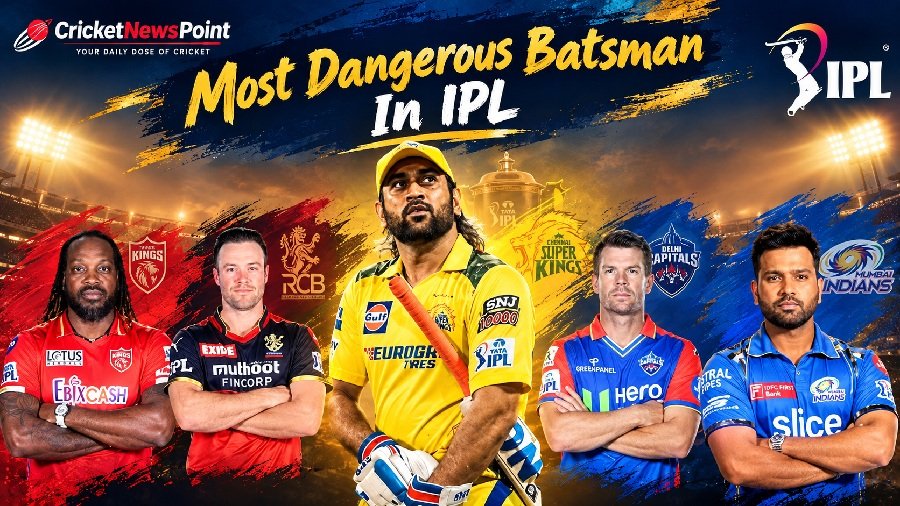
Rohit Sharma is one of the most naturally gifted stroke-makers in IPL history.
His timing is his greatest weapon. Rohit does not always need brute force to clear the boundary. His ability to hit through the line and generate enormous power from timing makes him extremely dangerous.
The former Mumbai Indians captain has produced numerous match-winning innings throughout his IPL career. His pull shot, lofted drives and pick-up shots have become particularly recognizable.
Rohit’s ability to attack during the powerplay also makes him a major threat. If he survives the first few overs, he can rapidly increase the scoring rate.
Why Rohit Sharma was dangerous
- Exceptional natural timing
- Powerful pull shot
- Strong six-hitting ability
- Experience against world-class bowlers
- Ability to dominate the powerplay
- Proven big-match performer
6. David Warner
David Warner has been one of the most successful overseas opening batters in IPL history.
The Australian left-hander combines aggression with consistency. Unlike some pure power hitters, Warner can score quickly while also maintaining a high level of reliability.
His aggressive approach is particularly effective in the powerplay. He uses strong bottom-hand control and excellent hand-eye coordination to attack both pace and spin.
Warner has also won multiple Orange Cap awards and produced several outstanding IPL seasons.
His ability to attack early while still remaining capable of batting deep into an innings made him one of the most difficult opening batters for opponents to control.
Why Warner was dangerous
- Aggressive opening style
- Excellent powerplay batting
- Strong against pace
- Excellent running between wickets
- Ability to play long innings
- Consistent run-scoring record
7. Jos Buttler
Jos Buttler has become one of the most destructive white-ball batters of his generation.
The English wicketkeeper-batter is particularly dangerous because he can combine conventional cricket shots with powerful improvisation.
Buttler’s 2022 IPL season was extraordinary. He scored 863 runs for Rajasthan Royals and won the Orange Cap. His campaign included four centuries.
His ability to attack from the opening over gives his team a major advantage. Buttler can score boundaries on both sides of the wicket and is particularly dangerous once he gets set.
Why Buttler was dangerous
- Explosive opening batting
- Excellent six-hitting
- Strong against pace
- Powerful against spin
- Ability to score centuries in T20 cricket
- Excellent range of attacking shots
8. Glenn Maxwell
Glenn Maxwell is another batter who can make conventional bowling plans look ineffective.
The Australian all-rounder is known for his unconventional shot selection, powerful hitting and ability to attack spin.
Maxwell can move around the crease and create unusual angles for bowlers. This makes it difficult for captains to establish defensive fields.
His 2014 IPL season was particularly memorable. The official IPL statistics record 36 sixes for Maxwell that season, including 29 in his first eight games.
His ability to produce a rapid burst of runs makes him especially valuable in the middle overs.
Why Maxwell was dangerous
- Unorthodox batting style
- Excellent against spin
- Strong six-hitting
- Ability to manipulate the field
- Explosive middle-order batting
- Capable of changing a match rapidly
9. Rishabh Pant
Rishabh Pant has established himself as one of India’s most aggressive modern T20 batters.
The left-hander is particularly dangerous because he does not restrict himself to conventional scoring areas. He can attack spin, pace and short-pitched bowling while using innovative strokes.
Pant’s fearless approach means that even difficult situations can become scoring opportunities.
His ability to attack spin during the middle overs is particularly valuable. Instead of allowing spinners to control the run rate, Pant often puts them under immediate pressure.
Why Pant was dangerous
- Fearless batting
- Innovative stroke play
- Strong against spin
- Powerful six-hitting
- Ability to attack from the middle order
- Excellent improvisation
10. Vaibhav Sooryavanshi
The IPL’s 2026 season introduced a remarkable young batting talent in Vaibhav Sooryavanshi.
At just 15 years old, Sooryavanshi produced one of the most extraordinary innings of the 2026 tournament when he scored 97 runs from only 29 balls for Rajasthan Royals in the Eliminator against Sunrisers Hyderabad.
His innings included 12 sixes and five fours, producing a strike rate of 334.48. The IPL’s official match report described the performance as one that rewrote record books.
He also hit eight sixes during the powerplay, according to the official IPL report.
The official IPL website’s 2026 season statistics list Sooryavanshi among the season’s leading performers, with 776 runs and 72 sixes.
His inclusion in this list is based on his demonstrated 2026 IPL impact rather than a long career sample. His performance showed just how quickly a young batter can influence an IPL match.
Why Sooryavanshi was dangerous
- Exceptional six-hitting
- Extraordinary strike rate
- Fearless approach
- Powerplay aggression
- Ability to attack experienced bowlers
- Record-breaking 2026 performances
IPL Dangerous Batsman: Comparison Table
| Batsman | Main Strength | Dangerous Phase | Key Feature |
|---|---|---|---|
| Chris Gayle | Power hitting | Powerplay & middle overs | Massive sixes |
| AB de Villiers | 360-degree batting | Middle & death overs | Innovative shots |
| Andre Russell | Finishing | Death overs | Explosive power |
| Virat Kohli | Consistency | Powerplay & middle overs | Chasing ability |
| Rohit Sharma | Timing | Powerplay | Natural stroke play |
| David Warner | Aggression | Powerplay | Fast starts |
| Jos Buttler | Power & range | Powerplay & middle overs | Six-hitting |
| Glenn Maxwell | Innovation | Middle overs | Spin destruction |
| Rishabh Pant | Fearless batting | Middle & death overs | Improvisation |
| Vaibhav Sooryavanshi | Explosive hitting | Powerplay | Extraordinary strike rate |
Who Is the Most Dangerous Batsman in IPL History?
There is no single statistical definition of the phrase IPL dangerous batsman.
If danger is measured primarily through raw power and six-hitting, Chris Gayle is one of the strongest historical examples. If innovation and shot range are considered, AB de Villiers stands out. For death-over destruction, Andre Russell has repeatedly demonstrated his ability to change games quickly.
Virat Kohli and David Warner represent a different type of danger: consistent scoring combined with the ability to accelerate. Jos Buttler has shown that he can combine power with long innings, while players such as Glenn Maxwell and Rishabh Pant can disrupt conventional bowling plans.
The emergence of Vaibhav Sooryavanshi in 2026 also demonstrates that the next generation of IPL batting can be even more aggressive.
What Makes a Batsman More Dangerous in the IPL?
The IPL is different from many other cricket competitions because of its combination of world-class bowlers, high-pressure matches, short boundaries at some venues and aggressive tactical approaches.
A dangerous batsman must therefore possess several skills.
Power Against Fast Bowlers
Fast bowlers can create opportunities through pace, but elite power hitters can use that pace against them.
Ability to Attack Spin
Spinners traditionally control the middle overs. Dangerous batters disrupt that strategy by using sweeps, slog-sweeps, lofted shots and movement around the crease.
Strong Powerplay Technique
The first six overs offer fielding restrictions. A batter who can exploit them can give his team a significant advantage.
Death-Over Hitting
The final five overs are crucial. Batters who can score 15 or more runs from an over can dramatically change the final total.
Mental Strength
A dangerous batsman must also handle pressure. IPL matches often involve huge crowds, playoff pressure and difficult run chases.
The Evolution of Dangerous Batting in IPL
The definition of a dangerous batsman has changed since the first IPL season.
In the early years, power hitters such as Brendon McCullum, Chris Gayle and Adam Gilchrist demonstrated how quickly an opening batter could transform a T20 innings.
Later, players such as AB de Villiers expanded the concept by introducing innovative 360-degree batting.
The modern IPL has gone even further. Batters now regularly target specific bowlers, use matchups, move around the crease and attempt high-risk shots from the first delivery.
The 2026 season provided another example of this evolution. The official IPL website recorded 1,426 sixes during the season, while Vaibhav Sooryavanshi finished as the Orange Cap winner with 776 runs. His 72 sixes also highlighted the increasingly aggressive nature of modern IPL batting.
Final Thoughts on the IPL Dangerous Batsman
The history of the IPL is filled with batsmen who could change matches within a few deliveries. Chris Gayle, AB de Villiers, Andre Russell, Virat Kohli, Rohit Sharma, David Warner, Jos Buttler, Glenn Maxwell, Rishabh Pant and Vaibhav Sooryavanshi represent different versions of what makes an IPL batsman dangerous.
Some rely on extraordinary power. Others use timing, consistency, innovation or exceptional finishing ability. What they have in common is the ability to put pressure on bowlers and change the direction of a match.
For cricket fans, that unpredictability is one of the biggest attractions of the Indian Premier League. A team can appear comfortable one moment and suddenly find itself under enormous pressure after an explosive batting spell.
That is why the term IPL dangerous batsman continues to generate so much interest. Every IPL season brings new power hitters, new records and new innings that challenge our idea of how quickly a cricket match can change.