
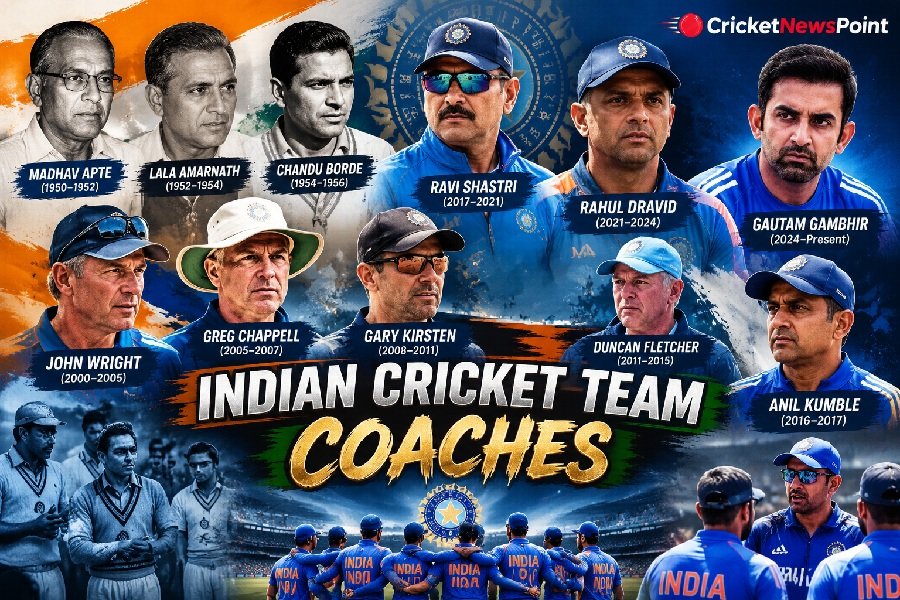

Introduction: The Men Behind Team India’s Success
Indian cricket team coaches are more than just tactical advisors. They are the backbone of the world’s most followed cricket team, shaping players, building strategies, and handling the immense pressure that comes with wearing the blue jersey.
From Gary Kirsten’s calm presence that delivered the 2011 World Cup to Gautam Gambhir’s fearless approach that has already brought two ICC trophies, the coach’s chair in Indian cricket is one of the most scrutinized jobs in world sport.
This article covers everything about the Indian cricket team coaches – the current support staff under Gautam Gambhir, the complete history of head coaches, and the key roles that keep Team India running at the highest level.
Current Indian Cricket Team Head Coach: Gautam Gambhir

Gautam Gambhir took charge as India’s head coach in July 2024, succeeding Rahul Dravid . His appointment marked a shift in philosophy – from Dravid’s methodical approach to Gambhir’s aggressive, result-oriented mindset.
Key achievements as head coach:
- ICC Champions Trophy 2025: India won the title with an unbeaten run, with BCCI praising Gambhir’s “fearless approach and tactical insight”
- T20 World Cup 2026: India successfully defended their T20 World Cup crown, giving Gambhir his second ICC title as coach
- Asia Cup 2025: Won with a 100% win record
Contract situation: Gambhir’s original contract runs until the end of the 2027 ODI World Cup . Reports suggest he is seeking an extension until the 2028 T20 World Cup in Australia .
Despite some turbulence in Test cricket, the BCCI has continued to back Gambhir, viewing the red-ball transition as a long-term project .
Indian Cricket Team Coaches: Current Support Staff
The current support staff is a mix of Gambhir’s trusted allies and new appointments made to address specific team needs.
Assistant Coach: Ryan ten Doeschate
The former Netherlands all-rounder joined alongside Gambhir in July 2024 . He also handles fielding duties, bringing an all-round perspective to the coaching setup .
Key role: Bridging the gap between batters and bowlers, and ensuring fielding standards remain high.
Bowling Coach: Morne Morkel
The former South African pacer was part of Gambhir’s original backroom team . Morkel’s experience in fast bowling across conditions makes him invaluable for India’s pace attack.
Key role: Managing the workload of India’s fast bowlers and developing young seamers.
Batting Coach: Sitanshu Kotak
Kotak’s appointment was a direct response to India’s batting struggles, particularly after the Border-Gavaskar Trophy loss in Australia . Gambhir specifically requested a batting coach who could work closely with senior batsmen.
Background:
- Played 8,061 first-class runs for Saurashtra at an average of 41.76
- Batting coach at NCA since 2019
- Known for his calm, communicative style
Strength and Conditioning Coach: Adrian Le Roux
Le Roux leads the fitness and conditioning program for the Indian team . His role is critical in managing player workloads across formats.
Throwdown Specialist: Raghavendra Dwivedi (Raghu)
Raghu is one of the most experienced throwdown specialists in the Indian setup, helping batsmen prepare for specific bowling types .
The Backroom Overhaul: What Changed in 2025
The BCCI has been actively revamping the support staff, moving away from the pre-Gambhir era .
Key departures:
- Rajeev Kumar (Masseur): Served the team for over a decade but was not given a new contract. The board believed that support staff staying too long can lead to “diminishing returns” .
- Abhishek Nayar (Batting Coach): Let go as part of the overhaul .
- Soham Desai (Strength and Conditioning): Also released by the BCCI .
The philosophy behind the changes: An influential member of the team’s decision-making unit felt that longtime support staff may develop a comfort level with players, which could hinder growth .
This aggressive restructuring shows the BCCI’s commitment to keeping the team environment fresh and competitive.
History of Indian Cricket Team Coaches: The Complete Timeline
The role of a dedicated coach evolved slowly in Indian cricket. For decades, the team had managers rather than professional coaches.
Early Managers (1971-1988)
| Coach/Manager | Tenure |
|---|---|
| Keki Tarapore | 1971 |
| Hemu Adhikari | 1971-74 |
| Gulabrai Ramchand | 1975 |
| Datta Gaekwad | 1978 |
| Salim Durrani | 1980-81 |
| Ashok Mankad | 1982 |
| PR Man Singh | 1983-87 |
| Chandu Borde | 1988 |
PR Man Singh is remembered as the manager during India’s historic 1983 World Cup triumph .
The Professional Era Begins (1990-2000)
Bishan Singh Bedi became India’s first proper coach in 1990, but the first full-time professional head coach was Ajit Wadekar (1992-1996) .
Key coaches:
- Kapil Dev (1999-2000): The legendary all-rounder’s tenure was short but impactful.
- John Wright (2000-2005): India’s first full-time foreign coach. He brought professionalism and structure, laying the foundation for modern coaching in Indian cricket .
The Foreign Influence (2005-2015)
- Greg Chappell (2005-07): Controversial tenure with strict methods that sparked debate .
- Gary Kirsten (2008-11): The golden era. Kirsten’s calm approach helped India win the 2011 World Cup and fostered a positive team environment .
- Duncan Fletcher (2011-15): Brought experience and strategic insight, emphasizing fitness and overseas success .
The Ravi Shastri Era (2014-2021)
Ravi Shastri served in multiple capacities – interim coach (2007), Team Director (2014-16), and full-time coach (2017-21) . Under his guidance, India achieved notable victories and consistency across formats.
The Dravid Transition (2021-2024)
Rahul Dravid, the “Wall” of Indian cricket, brought a methodical approach focused on technique and patience . His tenure ended on a high note with the T20 World Cup 2024 victory in Barbados .
The Gambhir Era (2024-Present)
Gautam Gambhir’s appointment signaled a shift toward a more aggressive, results-driven philosophy . With two ICC titles already in his bag, he has proven the BCCI’s faith correct.
Key Differences: What Makes a Great Indian Coach?
Looking at the most successful coaches in Indian cricket history, certain patterns emerge:
Gary Kirsten’s formula:
- Calm, player-first approach
- Built confidence rather than imposing tactics
- Created a positive team environment
Ravi Shastri’s strengths:
Gautam Gambhir’s philosophy:
- Fearless, aggressive approach
- Emphasis on self-belief and strategic execution
- Willingness to make tough calls on support staff
Summary Table: India’s Head Coaches Since 2000
Conclusion: The Coach’s Chair – Pressure and Privilege
The Indian cricket team coaches occupy one of the most demanding roles in world sport. Every decision is scrutinized, every result dissected, and every selection debated by millions.
The journey from Keki Tarapore’s managerial role in 1971 to Gautam Gambhir’s high-performance setup in 2026 reflects the evolution of Indian cricket itself. The current support staff combines experienced international minds like Morne Morkel and Ryan ten Doeschate with domestic stalwarts like Sitanshu Kotak.
What makes a successful Indian coach? The answer lies in balance. Gary Kirsten’s calm and Ravi Shastri’s aggression both worked because they suited the teams they led. Gautam Gambhir’s fearless approach is now delivering results, with two ICC trophies in hand.
The BCCI’s recent overhaul of the backroom staff shows a clear philosophy: freshness over familiarity, results over reputation. As India prepares for the 2027 ODI World Cup and beyond, the coaching setup will remain under the microscope.
For Indian cricket fans, the coach’s chair is more than a job title. It is a position of immense trust, carrying the hopes of a billion people every time Team India takes the field.
FAQ Section
Who is the current head coach of the Indian cricket team?
Gautam Gambhir is the current head coach of the Indian men’s cricket team. He took charge in July 2024 and has won the ICC Champions Trophy 2025 and T20 World Cup 2026 .
Who is India’s batting coach?
Sitanshu Kotak is India’s current batting coach. He was appointed in response to India’s batting struggles, particularly after the Border-Gavaskar Trophy loss in Australia. He previously served as batting coach at the National Cricket Academy .
How long has Gautam Gambhir been India’s coach?
Gautam Gambhir completed two years as India’s head coach in July 2026. He was appointed on July 9, 2024, and his contract runs until the end of the 2027 ODI World Cup .
Who was India’s coach when they won the 2011 World Cup?
Gary Kirsten was India’s head coach during the 2011 World Cup triumph. The South African’s calm approach and focus on player confidence were credited for India’s success .
Which Indian coach has won the most ICC trophies?
Gautam Gambhir has won two ICC titles as head coach – the Champions Trophy 2025 and T20 World Cup 2026. No other Indian coach has won multiple ICC trophies in the men’s game .