


Every cricket fan knows Virat Kohli as a run machine and a fierce competitor. But before the records, the centuries, and the captaincy, there was a nervous teenager walking out to bat in Sri Lanka. The first match of Virat Kohli was not a fairytale hundred. It was a tough introduction to international cricket that would eventually shape one of the greatest careers the sport has ever seen.
This article looks back at that modest beginning. We will break down his ODI debut, his first T20I, his first-class start, and why that initial failure mattered so much.
First Match of Virat Kohli: The ODI Debut
Virat Kohli made his international debut for India on August 18, 2008, in an One Day International (ODI) against Sri Lanka. The match took place at the Rangiri Dambulla International Stadium.
It was a difficult day for the young batsman. Opening the batting alongside Gautam Gambhir, Kohli faced 22 balls and scored just 12 runs before being dismissed by Sri Lankan pacer Nuwan Kulasekara in the eighth over. India struggled throughout the innings and were bowled out for a mere 146. Sri Lanka chased the target easily, winning the match by eight wickets.
While the result and his personal score were forgettable, this was the moment the journey began.
Virat Kohli’s First Match for India: The Circumstances
Kohli did not simply walk into the team. He earned his spot through a strong showing in domestic cricket and, crucially, by captaining India to victory in the 2008 ICC Under-19 World Cup in Malaysia.
His first international match came during a tour where India was looking to test new talent. At just 19 years old, Kohli was thrown into the deep end against a strong Sri Lankan side featuring spin wizards like Ajantha Mendis and Muttiah Muralitharan. The selectors wanted to see if the youngster from Delhi had the temperament to handle international pressure.
Virat Kohli’s First-Class Debut
Before the bright lights of international cricket, Kohli learned his trade in the grueling world of domestic first-class cricket.
He made his first-class debut for Delhi on November 23, 2006, against Tamil Nadu in a Ranji Trophy match at the Feroz Shah Kotla. In his first innings, he scored 10 runs.
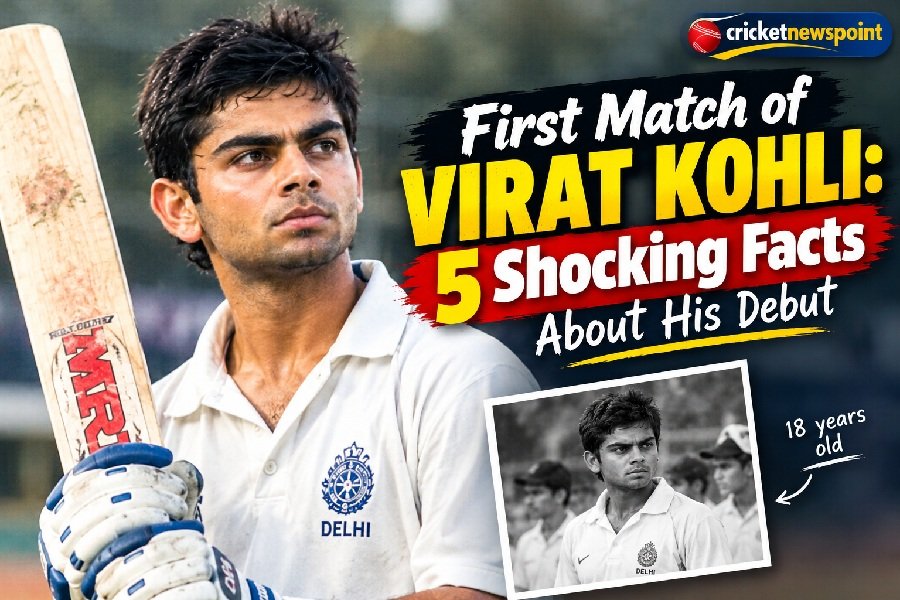
However, his most defining early moment came in a match against Karnataka later that season. Despite the tragic loss of his father overnight, an 18-year-old Kohli returned to the crease to bat for his team, scoring 90 runs to save the match. That innings revealed the mental steel that would define his career.
Virat Kohli’s First T20 International Match
After his ODI debut, Kohli had to wait nearly two years for his first T20 International. He played his first T20I on June 12, 2010, against Zimbabwe at Harare.
Unlike his ODI debut, this match went much better. Chasing a modest target of 112, India was in trouble at 48 for 4. Kohli walked in and played a composed, unbeaten knock of 26 runs off 21 balls, including three fours and a six. He shared an unbroken 64-run partnership with Yusuf Pathan to guide India home. This innings showed his ability to finish games under pressure.
Virat Kohli’s Early Career Journey
The transition from a U-19 star to a permanent member of the senior team was not instant. After his 12-run debut, Kohli had to wait for his first big score. He reached his maiden ODI century against Sri Lanka in Kolkata in December 2009.
What set Kohli apart was his hunger. He did not let the failure in his first match define him. Instead, he used the experience to learn. By the time he made his Test debut in 2011 against the West Indies, he had already become a crucial part of the ODI setup. The boy who scored 12 runs in Dambulla was slowly transforming into the “Chase Master” fans adore today.
Match Details Table
| Format | Date | Opponent | Venue | Performance |
|---|---|---|---|---|
| ODI Debut | August 18, 2008 | Sri Lanka | Dambulla | 12 runs (22 balls) |
| T20I Debut | June 12, 2010 | Zimbabwe | Harare | 26* runs (21 balls) |
| Test Debut | June 20, 2011 | West Indies | Kingston | 19 runs (total match) |
| First-Class Debut | November 23, 2006 | Tamil Nadu | Delhi | 10 runs |
Why the First Match of Virat Kohli Was Important
It is easy to look at the first match of Virat Kohli and see only a failure. A 12-run cameo in a losing cause does not scream “future legend.” However, that match was important for three reasons:
- Exposure: It gave him a taste of the pace, pressure, and skill level required at the highest level.
- Resilience: Kohli learned early that international cricket is unforgiving. He had to go back to the drawing board and work harder.
- The Start of a Journey: Every great story has a beginning. This was the first page. Without that tough day in Dambulla, there might not have been the 50+ ODI centuries that followed.
Frequently Asked Questions
1. When was the first match of Virat Kohli in international cricket?
His first international match was an ODI against Sri Lanka on August 18, 2008, in Dambulla.
2. How many runs did Virat Kohli score on his ODI debut?
He scored 12 runs off 22 balls before being dismissed by Nuwan Kulasekara.
3. Did Virat Kohli play in the 2008 Under-19 World Cup?
Yes, he captained India to victory in the 2008 U-19 World Cup and was a key performer.
4. What was Virat Kohli’s first T20I score?
He scored an unbeaten 26 runs off 21 balls against Zimbabwe in 2010.
5. Was the first match of Virat Kohli a win for India?
No, India lost the ODI match against Sri Lanka by eight wickets.
Conclusion
The first match of Virat Kohli is a reminder that even the greatest players start somewhere. It was not a debut of fireworks or instant stardom. It was a tough, gritty introduction to the demands of international cricket.
Looking back, that 12-run innings in Dambulla was the first step on a path that would lead to World Cup glory, Test captaincy, and countless records. For Indian cricket fans, it is a fond memory of where the legend began.


