
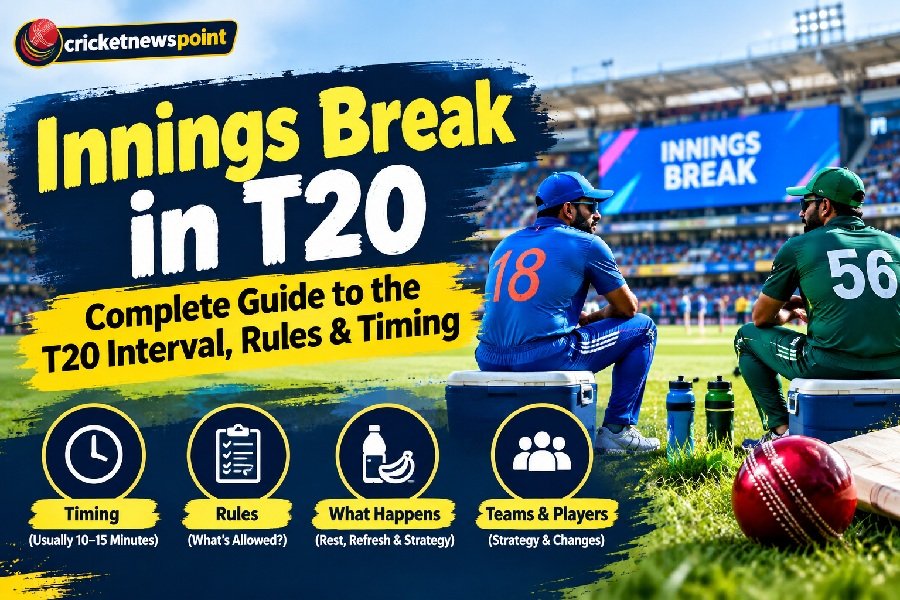

If you watch T20 cricket regularly, you have probably noticed the short break after the first team finishes batting. This period is known as the innings break in T20. It may look like a simple pause, but it plays an important role in the match.
The innings break gives players time to change roles, prepare for the second innings, review the first innings and adjust their strategy. For viewers, it is also the moment to check the target and think about how the chase could unfold.
Below is a complete guide to the innings break in T20, including its duration, what happens during the break, how weather interruptions can change it, and the difference between T20 internationals and tournaments such as the IPL.
What Is the Innings Break in T20?
The innings break in T20 is the interval between the first team’s innings and the second team’s innings.
A standard T20 match has two innings:
- Team 1 bats first.
- Team 2 bats second and chases the target.
- Each team can normally bat for a maximum of 20 overs.
- The innings break takes place after the first innings ends.
- During the break, teams prepare for the second innings.
In simple terms, if Team A scores 185/6 in 20 overs, the innings break begins after Team A’s innings and before Team B starts its chase of 186.
ICC playing conditions define an interval between innings, while the exact duration can depend on the competition and its current playing conditions.
How Long Is the Innings Break in T20?
The answer depends on the competition.
For T20 internationals, the ICC has introduced a fixed 15-minute interval between innings, with the possibility of reducing it to a minimum of 10 minutes when playing time has been lost. This is part of the ICC playing-condition changes effective in October 2026.
T20 innings break timing
| Competition/Scenario | Innings Break |
|---|---|
| T20I, normal conditions | 15 minutes |
| T20I, time lost | Can be reduced to 10 minutes |
| IPL 2026, normal uninterrupted match | 20 minutes |
| IPL 2026, certain delayed situations | Can be reduced to 10 minutes |
The IPL has its own playing conditions. The 2026 IPL rules specify a 20-minute interval between innings, while allowing the interval to be reduced in certain circumstances.
So, saying that every T20 match always has exactly the same break would be incorrect.
Why Is the Innings Break Important in T20?
T20 cricket moves extremely quickly. Teams have only 20 overs to score as many runs as possible or chase a target.
The innings break gives both teams a valuable opportunity to reset.
Main purposes of the break
- Players can change from batting to bowling or vice versa.
- Captains can discuss tactics.
- Coaches can analyse the first innings.
- Bowlers can prepare for their spells.
- Batters can understand the required run rate.
- Ground staff can check the playing conditions.
- Broadcasters can show scorecards and match analysis.
The break therefore has both a practical and tactical purpose.
What Happens During the Innings Break?
The action may stop on the field, but plenty of work continues behind the scenes.
1. Teams Review the First Innings
The coaching staff and captain quickly look at the first innings.
They may discuss:
- Total score
- Run rate
- Wickets lost
- Powerplay performance
- Middle-over scoring
- Death-over runs
- Bowling performance
- Important partnerships
For example, if a team scores 190 but concedes 65 runs in the final five overs, the bowling side may believe that the target is still manageable.
2. Batting Team Changes Its Strategy
The team batting second now knows exactly what it needs.
If the target is 181, the chasing team needs 181 runs to win.
A captain may divide the chase into smaller targets:
- 50 runs in the Powerplay
- Around 90–100 runs by 12 overs
- Strong acceleration from 15 overs onward
The exact strategy depends on wickets, pitch conditions and required run rate.
3. Bowlers Prepare
The bowling team gets a chance to organise its bowling plan.
The captain may decide:
- Which bowler starts the innings
- When the spinner should bowl
- Which bowler handles the death overs
- How to attack dangerous batters
- Which match-ups should be used
This is particularly important in modern T20 cricket, where match-ups between batters and bowlers can influence tactical decisions.
4. Pitch and Conditions Are Assessed
Players and support staff may also consider whether conditions have changed.
Important factors include:
- Dew
- Wind
- Pitch behaviour
- Ball movement
- Outfield speed
- Boundary dimensions
In an evening match, dew can become especially important because it may make the ball difficult for bowlers and fielders to grip.
Does the Innings Break Affect the Target?
No. The innings break itself does not change the target.
The target is normally one run more than the first team’s final score.
For example:
- Team A: 175/7
- Team B’s target: 176
If Team B scores 176 before its allotted overs are completed, it wins the chase.
The break simply separates the two innings.
What If the First Innings Ends Early?
A T20 innings does not always last 20 overs.
A team can be:
- Bowled out before 20 overs
- Win/lose through a match situation before completing the available overs
- Have its innings shortened because of weather or another interruption
If the batting side is bowled out early, the second team normally still has its allotted number of overs, subject to the match’s playing conditions and any interruption.
ICC T20 playing conditions state that in an uninterrupted match, each side can bat for up to 20 overs, unless it is dismissed earlier.
What Happens If Rain Delays the Innings Break?
Rain can make the situation more complicated.
If time is lost during the first innings, officials may have to adjust:
- Length of the first innings
- Number of overs
- Start time of the second innings
- Length of the innings interval
The objective is to maximise the amount of cricket that can be played while still maintaining a fair contest.
Under current ICC T20I rules, the normal 15-minute interval can be reduced to 10 minutes when time has been lost.
Innings Break and DLS Method
The DLS method can become relevant when rain or another interruption reduces the number of overs available.
For example, suppose:
- Team A bats first.
- Rain interrupts the match.
- Team B can no longer receive 20 overs.
Officials may calculate a revised target based on the available overs and resources.
The innings break is therefore not simply a fixed clock period in an interrupted match. Match officials must consider the revised playing schedule and competition rules.
Innings Break in IPL
The IPL innings break follows the tournament’s own playing conditions.
For the 2026 IPL, the official playing conditions specify a 20-minute interval between innings in normal circumstances. The rules also allow the Match Referee to reduce the interval in certain delayed or interrupted situations, with a minimum of 10 minutes in the specified circumstances.
This is important because many fans use “T20” and “IPL” interchangeably, but they are not exactly the same from a rules perspective.
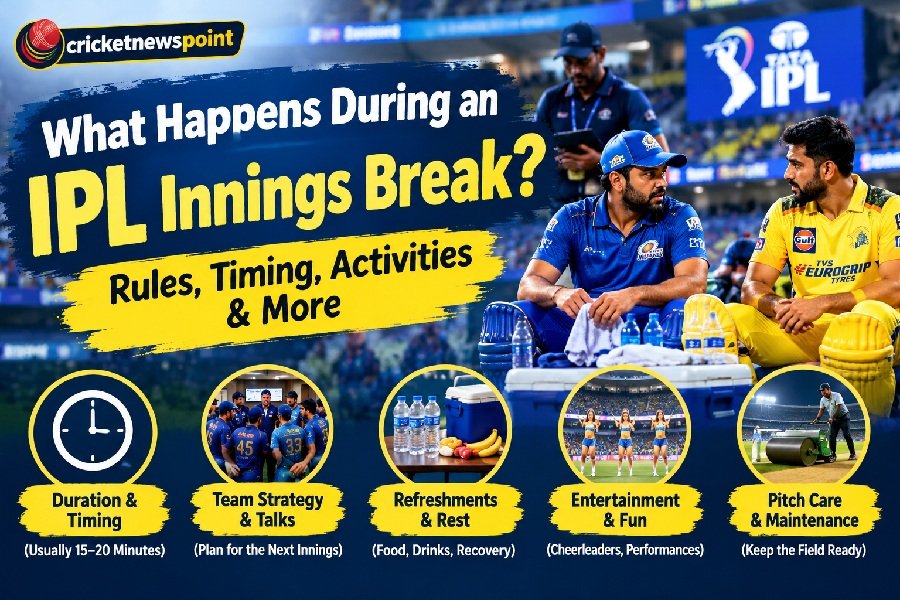
What happens during an IPL innings break?
During the IPL break, fans usually see:
- First-innings scorecard
- Player statistics
- Expert analysis
- Team discussions
- Pitch reports
- Target calculation
- Advertisements and entertainment
- Players preparing for the chase
The break also creates a natural transition from the first half of the match to the second.
Innings Break vs Drinks Break in T20
These two terms are different.
Innings Break
The innings break happens between the two innings.
Drinks Break
A drinks break occurs during an innings, depending on the competition’s playing conditions.
Current ICC T20I conditions also contain provisions for scheduled drinks intervals, subject to the applicable playing conditions.
So, if a commentator says “innings break,” they are referring to the transition between the first and second innings.
How Can Teams Use the Innings Break Strategically?
The short interval can influence the second half of the match.
For the team batting first
The team can:
- Assess whether its score is competitive.
- Identify weaknesses in its bowling plan.
- Select the best bowlers for specific phases.
- Plan how to defend against dangerous batters.
For the chasing team
The team can:
- Calculate the required run rate.
- Identify the opposition’s key bowlers.
- Plan the Powerplay.
- Decide when to attack.
- Protect wickets for the final overs.
In T20 cricket, even a few tactical decisions can change the result.
Why Is the Innings Break Important for Cricket Fans?
For viewers, the break is the perfect time to understand the match situation.
Fans can check:
- Total score
- Required runs
- Required run rate
- Wickets remaining
- Overs remaining
- Top run-scorers
- Best bowlers
- Powerplay statistics
- Partnership statistics
A score of 160 may look strong on one pitch but modest on another. The innings break allows experts and fans to analyse the context before the chase begins.
Key Facts About Innings Break in T20
Here are the most important points to remember:
- The innings break comes between the two innings.
- A standard T20 match has a maximum of 20 overs per side.
- Current ICC T20I rules specify a 15-minute normal interval.
- The T20I interval can be reduced to 10 minutes when time has been lost.
- Domestic competitions can have different playing conditions.
- The IPL’s 2026 playing conditions specify a 20-minute interval in normal circumstances.
- Rain can lead to changes in the interval and overs.
- DLS calculations may apply in rain-affected matches.
- The break is important for tactical planning and player preparation.
Innings Break in T20: Quick Summary Table
| Feature | Details |
|---|---|
| Meaning | Break between the first and second innings |
| Format | T20 cricket |
| Maximum overs per side | 20 overs |
| Current T20I normal interval | 15 minutes |
| Minimum T20I interval when time is lost | 10 minutes |
| IPL 2026 normal interval | 20 minutes |
| Purpose | Rest, tactical planning and preparation |
| Target | Usually first-innings score + 1 |
| Rain impact | Overs and interval may be adjusted |
| DLS | May apply in interrupted matches |
The ICC’s latest playing-condition information confirms the 15-minute T20I interval, while the official IPL 2026 playing conditions specify their separate interval provisions.
Conclusion: Why the Innings Break in T20 Matters
The innings break in T20 is much more than a simple pause between two halves of a match. It is a crucial transition point where the first innings is analysed and the second innings begins to take shape.
For T20 internationals, the current ICC rule provides a 15-minute interval, which can be shortened to 10 minutes when playing time has been lost. However, tournaments such as the IPL can operate under their own playing conditions, so the exact duration is not identical across every T20 competition.
For cricket fans, this break is the ideal moment to study the scorecard, understand the target and predict how the chase might develop.
FAQs About Innings Break in T20
1. What is the innings break in T20?
The innings break is the interval between the first team’s innings and the second team’s innings.
2. How long is the innings break in T20?
Under the current ICC T20I playing conditions, the normal interval is 15 minutes. It can be reduced to 10 minutes when time has been lost.
3. Is the IPL innings break 15 minutes?
Not necessarily. The 2026 IPL playing conditions specify a 20-minute interval in normal circumstances, with provisions for reducing it in certain situations.
4. What happens during the T20 innings break?
Players rest and prepare for the next innings, while captains and coaching staff discuss tactics, targets, bowling plans and match conditions.
5. Can rain change the innings break in T20?
Yes. Weather interruptions can result in changes to the interval and the number of overs available. In T20Is, the interval can be reduced when playing time has been lost.